How Slay the Spire 2 Recovered by Losing 10,809 Reviews
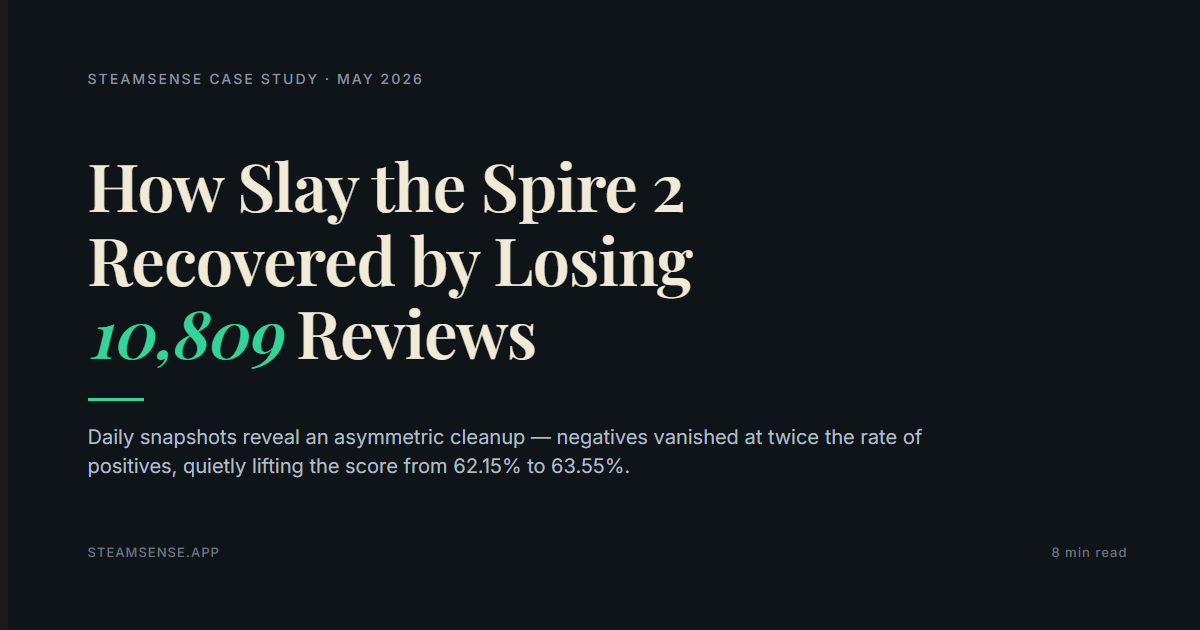
On May 7, 2026, Slay the Spire 2 had 153,315 Steam reviews. By May 30, it had 142,506.
Its review score went up.
This is the story of what happened in between — a 30-day window during which Steam's recommendation system, players themselves, or some combination of forces quietly removed more than ten thousand reviews from a single game's storefront. And it's the story of why the game's reputation recovered not by winning new fans, but by losing old critics.
We tracked it daily. Here is what the data shows.
The third strike
Slay the Spire 2 launched into early access on March 5, 2026. For most of its first month, it sat at "Overwhelmingly Positive" with a 97% rating — the rare sequel that fans and lapsed players both embraced.
Then it was review-bombed three times in seventy days.
The first wave hit in mid-April, after a balance patch nerfed dominant deck archetypes. The second arrived ten days later, when a follow-up patch doubled down on those changes. The third — and the one this article focuses on — began on May 7, when players discovered that Anita Sarkeesian was credited as a consultant in the game's about screen. Within 48 hours, Steam itself flagged the game with an "off-topic review activity" notice.
The first two waves are largely outside our data — we only began daily snapshots on May 1. But the third wave we captured in full, from setup to aftermath. And the aftermath turned out to be more interesting than the bombing.
A single day, 3,589 missing reviews
Between May 1 and May 7, Slay the Spire 2 gained reviews at a steady, slightly accelerating pace — about 1,000 to 1,600 new reviews per day, with the count climbing from 146,277 to 153,315. The May 7 spike was the visible signature of the Sarkeesian-driven bomb.
Then May 8 happened.
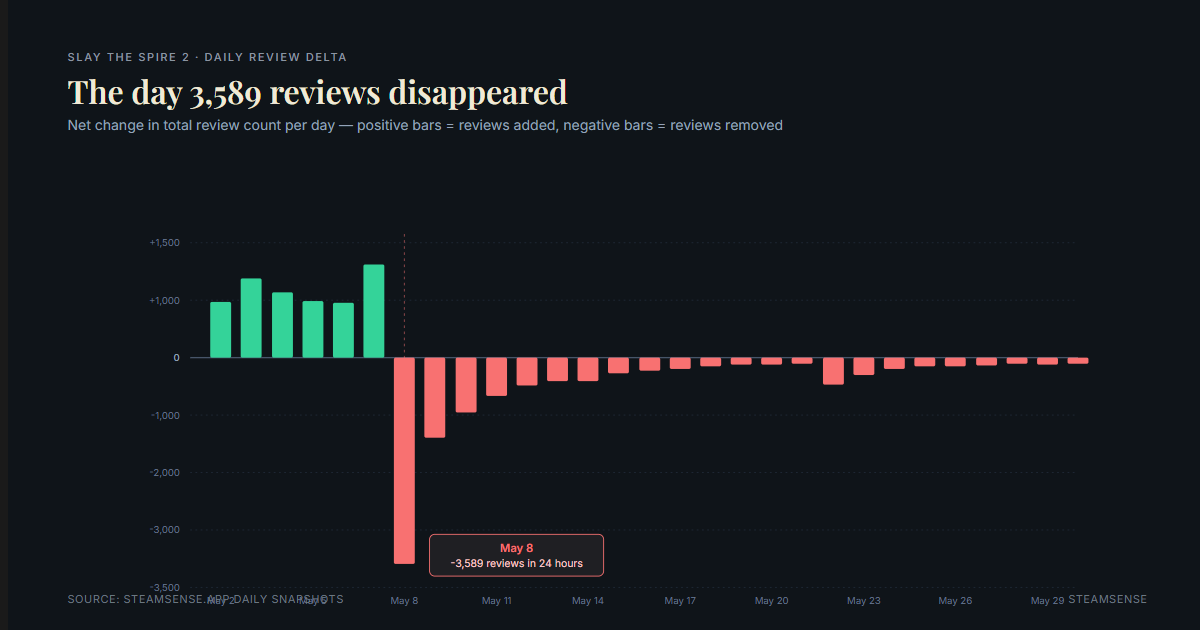
In a single 24-hour window, the game's total review count fell from 153,315 to 149,726. That is a net loss of 3,589 reviews — overnight, with no announcement, no notification, no public log.
Steam does not publish individual review deletions. The only way to see this happen is to record the totals yourself, every day, and watch the gaps appear. We did, and the composition of the May 8 deletion is where the story really begins.
Of the 3,589 reviews that vanished that day, 1,484 were positive and 2,105 were negative.
That ratio matters. On the morning of May 7, negatives made up 37.85% of all reviews for Slay the Spire 2 (58,035 of 153,315). But on May 8, negatives accounted for 58.65% of the deletions. The cleanup was not proportional to the existing pool — it skewed heavily toward the negative side. Whatever mechanism was removing reviews on May 8, it was finding more negatives than the law of averages would predict.
The slow burn
What happened on May 8 was dramatic, but it was not the whole story. The cleanup continued for the next three weeks, just much more quietly.
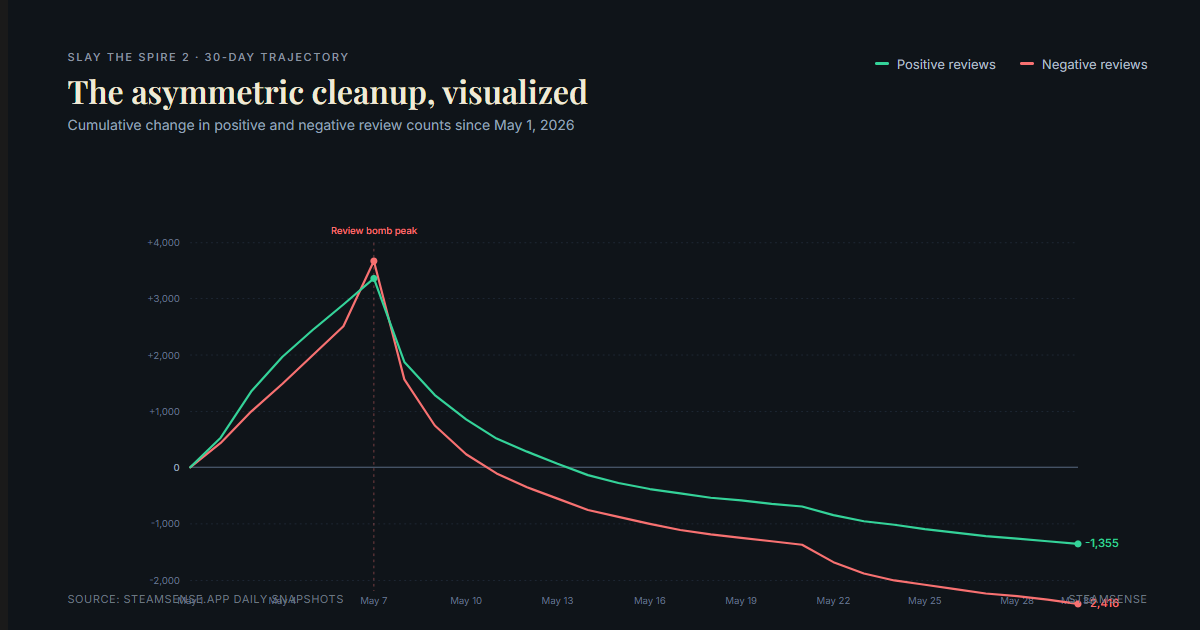
Between May 7 and May 30, the game's total review count drifted downward almost every single day — losing somewhere between 100 and 1,400 reviews per day, with no further spikes. By May 30, the total had fallen to 142,506. Across those 23 days after the peak:
- 6,087 negative reviews disappeared (58,035 down to 51,948, a 10.49% drop)
- 4,722 positive reviews disappeared (95,280 down to 90,558, a 4.96% drop)
In other words: negatives died at 2.12 times the rate of positives.
That asymmetry — sustained over three weeks — is what drove the recovery. The game's review score climbed from 62.15% positive on May 7 to 63.55% on May 30, a 1.4-point rise. But it did not climb because new positive reviews flooded in. It climbed because negative reviews kept quietly vanishing.
A counterfactual makes the point sharper. Suppose only the positive reviews had decayed at their observed rate, and the 58,035 negatives from May 7 had been left untouched. By May 30, Slay the Spire 2's score would read 60.94% — meaningfully worse than where it actually ended up. The 263 basis points between 60.94% and 63.55% are, almost entirely, the visible footprint of the cleanup.
Who, or what, is doing this?
There are three plausible mechanisms behind the asymmetric removal. From the outside, they are indistinguishable in the aggregate data.
The first is Steam's own off-topic review system. After the May 7 spike, Steam appended an "off-topic review activity" notice to the game's storefront and excluded the flagged reviews from the displayed score. While Steam's public communication describes this as an exclusion, the actual review counts on the storefront fell, which suggests deletions or some equivalent removal — not just visual filtering.
The second is players deleting their own reviews. Steam allows a reviewer to remove a review at any time. It is plausible that some players, after a few days of reflection or after seeing their review surrounded by hundreds of similar ones, chose to withdraw what they wrote. The data cannot distinguish a contrite reviewer from a moderated one.
The third is reports from the developer. Steam allows publishers to flag reviews that violate the terms of service. Mega Crit, the studio behind Slay the Spire 2, almost certainly used this channel — every studio in a review-bomb situation does — though we have no way of knowing how many of those flags were upheld.
Three causes, one signature. What we can say with confidence is that the aggregate result is the same regardless of cause: in a post-review-bomb window, negative reviews leave the platform faster than positive ones, and the visible score quietly recovers.
What this means for developers
If you are a developer staring at a review bomb in progress, the data has a clear and slightly uncomfortable suggestion: the curve recovers without you.
In the Slay the Spire 2 timeline, no developer post, no balance patch, and no public statement during the recovery window appears to have produced a visible inflection in the data. The shape of the curve from May 8 onward is almost monotonically downward — a slow, mechanical drain on the negative side, with the positive side decaying at its normal rate.
This is not an argument for ignoring your community. Communication matters for trust over the long arc. But the data is consistent with the idea that the score recovers on its own, on a timescale of about thirty days, given Steam's current moderation aggressiveness. The most impactful thing a developer can do in those thirty days might be to not make the situation worse.
A note on method
The numbers in this article come from daily snapshots of the public Steam review counts for Slay the Spire 2, taken by SteamSense between May 1 and May 30, 2026. We record the total review count, positive count, and negative count for around 880 actively tracked games every day at 03:00 UTC, allowing us to compute daily deltas that are not visible on Steam's storefront itself.
Steam's storefront only shows you the current state. It does not show you the path the score took to get there — the spikes, the deletions, the quiet downward grind of a post-bomb cleanup. That path is what this kind of longitudinal tracking surfaces, and it is often where the real story lives.
Slay the Spire 2 is one such story. There will be others.
Data and analysis by SteamSense, a free Steam review tracking tool. You can see the live trends page for Slay the Spire 2 here.